Global Warming Threatens Morocco: Morocco Responds
Climate change is a potentially devastating threat to Morocco and other North African countries, but even as the United States has abdicated its global responsibility, Morocco is among the leaders in the fight to mitigate its effects.
Even as a recent article in New York Magazine has created shock waves with its nightmare worst case scenario in the event of unchecked climate change — a virtually uninhabitable planet — more focused studies have predicted that the impact of climate change will fall particularly heavily on North Africa and the Middle East. In particular the region is threatened by potential flooding, decreased rainfall and food production, and soaring heat waves, and some experts have speculated the region may become uninhabitable.
Is the Rif Rising?
The Rif is not the Morocco I know. Al Hoceima was a sleepy beach resort when I stopped by for a couple of days, and I spent an overnight in Chefchauen, but I never got to know the people. The time I spent among the Amazigh was in the Middle Atlas, and even then I learned only three words of Tamazight - aghram (bread), aman (water), and tarbet (girl). The guys would tell me that these were the essentials of life. The language I learned was colloquial Arabic,and my acquaintance with Shilha culture was incidental.
Islam and Politics
I just attended a very interesting lecture at the D.C. Rotary Club by Dr. Shadi Hamid, an author and senior fellow at the Brookings Institution, on the interplay between Islam and politics. His thesis is that Islam is “exceptional” owing to a fusion of religious and political consciousness. He attributes this in part to the fact that the Prophet was not only a religious leader but an early head of state. In addition, he posits that Muslims subscribe to the belief that the Qu’ran is the words of God transmitted directly without human authorship or mediation, and that this gives the scripture unique moral and political authority.
Women Lead Protests Against Morocco's Misguided Development Policy

Women in Morocco are at the forefront of resistance to destruction of traditional practices of holding land in common, according to a recent article in the New York Times. The Moroccan state is in the process of privatizing tribal common lands — known as Sulaliyyate — in the name of economic efficiency. The Morocco Free Trade Agreement with the United States has accelerated the government’s privatization program as foreign investors seek to acquire land. The trade off between social welfare and trade liberalization should be familiar to every American who has not been asleep in the 30 years since the North American Free Trade Agreement (NAFTA) went into effect thirty years ago.
Fresh Impressions — Morocco Through the Eyes of Susan Davis
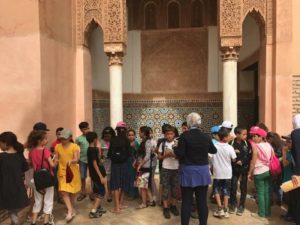 My friend Susan Davis recently traveled to Morocco on a cultural exchange tour sponsored by the United States Department of State. Ms. Davis — a poet and a broadcaster — recorded her candid impressions of the country in a series of dispatches home. What follows is a sample of her observations and photographs from her tour._
Rabat
My first impressions of Rabat were hot, dry and salty. It smells a lot like coastal Israel. It’s green with palm trees, cypress, Jacaranda and Bougainvillea. The buildings are officious — it’s the Capital — and several parks are under construction. My hotel was once a palace and the public spaces were truly magnificent with intricate tile work and chandeliers, terraces with mature gardens and high-ceilinged dining rooms with marble floors and carved moulding. 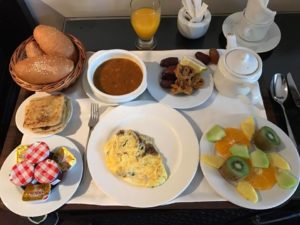 This morning I had a traditional Moroccan breakfast: fresh fruit, a mushroom omelet, a bowl of harira (a tomato based lentil soup that you squeeze lemon juice into) dates, a pastry of fried dough dipped in honey and covered with sesame seeds, three Moroccan pancakes served with butter and jam and several loaves of Moroccan bread which is shaped and used like pita but is made with barley flour and is doughy. Also, sweet black coffee and fresh orange juice.
Press Freedom in Morocco — Not Quite There Yet

Human Rights Watch has released a new report on press freedom in Morocco. The report — The Red Lines Stay Red: Morocco’s Reforms of its Speech Laws — offers guarded praise of Morocco’s recent reforms to its press code, but notes that there are still potential harsh penalties, including jail time, for violation of the penal code. The new press code has reduced penalties for crossing the country’s famous red lines — disparagement of Islam, the King, or the status of the Sahara — given news outlets greater due process before publications can be seized, and made it easier to present evidence for the defense in defamation trials. Prison time is eliminated for defamation of individuals or foreign diplomats. Certainly this is an improvement over the prior 2002 press law, but clearly it does not go far enough to provide truly free speech.
Moroccan Wildlife on the Brink
 The Barbary Macaque, unique to North Africa and most prevalent in Morocco, is in imminent danger of extinction, according to the Daily Mail. Although Moroccan conservation authorities are working to preserve and manage the remaining population, the monkeys face multiple threats from poachers, pet seekers, and tourists who feed the monkeys. Obesity and other illnesses not only threaten the health of the monkeys, but also result in reduced fertility. Chief among the threats, however, is deforestation and loss of habitat.
Ben Jelloun to Le Pen Voters: Pack Your Bags
Famed Moroccan author Tahar Ben Jelloun, known particularly for his novels in French, had some sharp words for the 750 French expatriates in Morocco who voted for Marine le Pen: “it is time to leave.” Ben Jelloun writes, “Even though Morocco is above all a country that is hospitable, open, and generous, it otherwise demands respect.” Ben Jelloun has not forgotten that following a speech by Jean-Marie le Pen, blaming Moroccans for unemployment, a young Moroccan was thrown into the Seine. And he has not forgotten that after an admittedly horrible murder by a young Algerian man named Mohamed Merah, Marine le Pen’s comment was that “the boats, the airplanes, will soon arrive full of Mohamed Merahs.” Ben Jelloun denounces the Front National as “neither a party of the Left nor of the Right, but one that is at its base racist and violent and would have the French believe that solutions derive from barring foreigners from France.” For the sake of self-consistency, Ben Jelloun argues that people who hate Arabs and Muslims should not continue to benefit from living in Morocco. The taste must be particularly bitter when it comes from former colonizers living among the people they colonized. To paraphrase Mr. Talleyrand, they have learned nothing and forgotten nothing since 1956.